Raúl Chío León1, 2
1 Eigen Biotech (umbrella). 2 Tecnológico de Monterrey, Campus Guadalajara, Mexico.
Correspondence: raul.chio.leon@gmail.com.
Authorship note: this first manuscript is prepared as a solo-author submission by default. External biological or technical reviewers may be acknowledged, with permission and with their specific contribution named, but they are not listed as authors unless their contribution meets journal authorship criteria and they approve and accept accountability for the submitted work.
Local use of open protein-structure models is attractive for
researchers without CUDA cluster access, but hardware-viability claims
need target-level evidence rather than anecdotes. We report an 8-target
reproducibility benchmark of SimpleFold-3B on a 128 GB M3 Max
workstation, using a direct local CLI route and public audit artifacts.
Phase 1A froze the target set (13CZ:A, 13EE:A,
13FT:A, 11BC:C, 12OY:A,
9H8N:A, 9K9X:A, 9K9Y:A) before
the four prospective targets were executed. All 8 targets produced
predictions and scores. Across the frozen set, median wall-clock time
was 395.96 seconds, median approximate peak RSS was 34.08 GB, median
sequence-aligned lDDT was 0.8597, and median TM-score was 0.9218. The
three long-bin targets (565-604 aa) completed without OOM at 34.02-34.64
GB peak RSS. Selective repeat controls now cover the 13CZ:A
route/cache anchor plus the reviewer-sensitive 11BC:C
hard/coverage target and 9K9Y:A long-bin target. This is
not a model leaderboard, not a reproduction of the SimpleFold CASP14
headline benchmark, not an official AlphaFold 3 evaluation, and not a
biological generality claim. Under this exact model, hardware, execution
route, target set, and scorer, local SimpleFold-3B inference was
operationally viable and auditable; the clean source snapshot and
release bundle are archived at Zenodo DOI
10.5281/zenodo.20275055.
Protein structure prediction has changed shape in 2024-2026. AlphaFold 3 (Abramson et al. 2024) introduced a diffusion-based all-atom architecture, while open and partially open systems such as Chai-1 (Chai Discovery 2024), Protenix-v1 (authors 2026), Boltz-2 (Wohlwend et al. 2025), and SimpleFold (Apple ML Research 2026) made parts of the ecosystem inspectable outside proprietary services. For small labs, the practical question is not whether Apple Silicon is generally sufficient for modern protein prediction. The defensible question is narrower: whether a specified model, route, machine, target set, and scorer can run with enough provenance for another researcher to audit.
SimpleFold is a useful first anchor because it provides an MLX path and model sizes up to 3B parameters. The M3 Max workstation (16-core CPU, integrated GPU, 128 GB unified memory) has enough memory headroom to attempt this route without a CUDA cluster. Community reports of such runs remain scattered and often omit exact checkpoints, route choice, scoring method, memory measurement, target context, or negative evidence. This paper therefore treats local inference as an empirical reproducibility problem rather than a hardware marketing claim.
Agent-assisted biology systems such as ProteinMCP (Xu et al. 2026), Agentomics (BioGeMT 2026), and Biomni (Snap-Stanford 2025) motivate machine-readable scientific workflows. This paper does not evaluate autonomous scientific discovery. LLM tooling is used here as documentation, curation, and verification support around a conventional benchmark; the scientific claim rests on executed predictions, scoring outputs, logs, cards, and environment provenance.
| Claim | Evidence | Limitation |
|---|---|---|
| SimpleFold-3B completed Phase 1A on Apple Silicon. | 8/8 frozen targets produced predictions and scores in
pilot/data/simplefold3b_phase1a_summary.*. |
One model, one M3 Max machine, one direct CLI route. |
| Long-bin targets did not OOM under this route. | 9H8N:A, 9K9X:A, and 9K9Y:A
completed at 34.02-34.64 GB approximate peak RSS. |
RSS is sampled process RSS, not full unified-memory profiling. |
| Selected structural scores are repeat-stable. | 13CZ:A, 11BC:C, and 9K9Y:A
each have n=3 controls with stable lDDT/TM-score and aligned-residue
counts. |
Five Phase 1A targets remain single-run observations. |
| Scoring is auditable. | Sequence-aligned lDDT, USalign TM-score, aligned-residue counts, cards, JSON summaries, logs, and 14-card score recomputation are public. | External biological interpretation remains limited without domain review. |
| The benchmark is reproducible as an artifact. | Environment card, model/runtime card, checkpoint hashes, target manifest, recipes, predictions, and scores are versioned. | Full inference reproduction requires comparable local hardware and SimpleFold checkpoint access; scoring/artifact reproduction is the lighter-weight path. |
AlphaFold 3 established the all-atom diffusion template for contemporary biomolecular structure prediction (Abramson et al. 2024), but the official model remains outside the scope of a fully reproducible local benchmark because of gated weights and licence constraints. The open ecosystem is therefore the relevant substrate for this study. Chai-1 exposes an open all-atom co-folding model and code path, but its upstream package documents a Linux/CUDA expectation; Protenix-v1 reports a fully open AlphaFold3-family system under an AlphaFold3-aligned cutoff and model scale; Boltz-2 adds affinity prediction but its primary path remains CUDA-oriented. These systems define the broader ecosystem, while their local portability remains uneven.
SimpleFold (Apple ML Research 2026) is the strongest initial anchor for this study because its repository supports both PyTorch and MLX inference and provides model sizes from 100M to 3B. Its architecture deliberately omits several domain-specific AF2/AF3 modules, including triangle attention and explicit pair representation biases, while retaining competitive benchmark performance. That combination makes SimpleFold unusually suitable for separating two questions that are often conflated: model-method validity and workstation-substrate viability.
Community conversion paths such as chai-mlx and prospective
MLX/OpenFold3 forks are treated as viability findings rather than
assumptions. If a model has open weights but no stable Apple Silicon
path, the correct result is not omission; it is a
port_unavailable, dependency_missing, or
port_runtime_error tag with exact installation
evidence.
Agent-assisted biology systems such as ProteinMCP (Xu et al. 2026), Agentomics (BioGeMT 2026), and Biomni (Snap-Stanford 2025) motivate machine-readable interfaces for scientific workflows. In this paper, however, the assistant layer is deliberately secondary. The Phase 1A evidence does not evaluate autonomous scientific discovery, autonomous paper reading, or autonomous biological interpretation. Instead, LLM tooling is used as documentation, curation, and verification infrastructure around a conventional benchmark run. The benchmark claim therefore rests on frozen targets, executed predictions, scoring outputs, logs, cards, and environment provenance, not on an unevaluated autonomy claim.
Reproducibility work in this space must handle two different failure modes: scientific non-reproduction and engineering non-viability. A model can be scientifically strong while unavailable on a target substrate; conversely, a port can run while producing numerically divergent results. This study therefore treats installation, inference, scoring, and audit persistence as first-class observations, not just preliminary setup.
We pre-register the following candidate classes for the broader Phase 1B expansion. These models define the intended atlas direction; they are not evidence for the current Phase 1A claims. Phase 1A deliberately starts with SimpleFold-3B because it already has a native MLX route, an observed install path, and working runner telemetry.
| Model | Source | Apple Silicon path | Parameters |
|---|---|---|---|
| SimpleFold-3B (Apple ML Research 2026) | Apple ML Research, ICLR 2026 | Native MLX | 3 B |
| Chai-1 via chai-mlx | Chai Discovery 2024 + community MLX weights/port | Native MLX (community) | contemporary all-atom candidate |
| ESMFold (ESM-2 backbone) | Meta / EvolutionaryScale | PyTorch + MPS | up to 15 B |
| Protenix-v1 (authors 2026) | Open AlphaFold3-family model | Unverified (subject to viability finding) | large biomolecular candidate |
| Boltz-2 (Wohlwend et al. 2025) | Open structure + affinity model | CUDA primary path; MPS community path is a caveat | structure + affinity candidate |
We deliberately exclude AlphaFold 3 official (gated weights), AlphaProteo (closed), IsoDDE (closed), and Chai-2.x (closed). Boltz-2 is retained as an optional stress case only if the community MPS path is stable enough to avoid attribution confusion (colbyford 2025).
The broader candidate freeze was generated on 2026-05-13 using the
RCSB Search and Data APIs and is stored as
pilot/data/test_set_v1_candidates.csv. On 2026-05-17 we
froze a smaller first publishable unit,
test_set_v1_phase1a, by taking the 8
provisional_keep rows from the target-review triage. This
prevents opportunistic target selection while keeping the first study
feasible for a single workstation and a first paper.
| Target | Bin | Length | Role | Pre-freeze evidence |
|---|---|---|---|---|
13CZ:A |
mid | 161 | repeat-control anchor | technical smoke observed |
13EE:A |
mid | 161 | benchmark slice | benchmark slice observed |
13FT:A |
mid | 228 | benchmark slice | benchmark slice observed |
11BC:C |
hard | 116 | alignment-coverage probe | benchmark slice observed |
12OY:A |
hard | 304 | membrane/complex context | prospective |
9H8N:A |
long | 604 | membrane/transport stress | prospective |
9K9X:A |
long | 565 | long enzyme context | prospective |
9K9Y:A |
long | 565 | long enzyme/ligand context | prospective |
The freeze is computational rather than biological: final interpretation still requires domain review of the target set. The original 24-chain, multi-model design remains the Phase 1B expansion.
The target-set design used explicit inclusion and exclusion rules. Inclusion required an available RCSB reference structure, a single labelled chain suitable for a first-pass monomeric SimpleFold run, representation across mid/hard/long bins, and at least one prospective post-freeze long target. Exclusion removed entries that would require ligand placement, affinity evaluation, multi-chain co-folding, or biological mechanism interpretation to support the primary claim. The result is a computational viability set, not a biologically representative protein-family sample.
We therefore generated a structured biological pre-review packet from
the frozen manifest, the Phase 1A result summary, and RCSB entry/entity
metadata. All eight targets are acceptable for the bounded
operational-viability claim, but two targets are explicitly blocked from
biological generality: 11BC:C, because only 63 aligned
reference residues were scored, and 12OY:A, because its
membrane/complex cryo-EM context and 3.6 Å resolution make it a stress
case. The paired DcrB structures (13CZ:A,
13EE:A) are retained as controls but are not treated as
evidence for broad protein-family generality, and 9K9Y:A is
not used for ligand-placement or affinity claims.
| Target | Experimental context | Inclusion rationale | Interpretation limit |
|---|---|---|---|
13CZ:A |
X-ray, 2.136 Å; DcrB, Salmonella enterica; 161 aa. | Paired DcrB mid-length route/repeat anchor with prior CLI evidence. | Useful as route/repeat evidence; does not generalize beyond the paired DcrB family. |
13EE:A |
X-ray, 1.729 Å; DcrB, pH-variant pair; 161 aa. | Mid-bin DcrB benchmark slice paired with 13CZ:A. |
Same-family pairing prevents broad biological-family inference. |
13FT:A |
X-ray, 2.01 Å; STARD3 START-domain; 228 aa. | Clean mid-bin lipid-transfer domain quality anchor. | Single target only; no family-level claim. |
11BC:C |
Electron microscopy, 3.3 Å; HIV-1 Rev in complex; 116 aa label. | Hard-bin alignment-coverage and complex-derived scoring probe. | Only 63 reference residues aligned; use for scoring QA, not full-chain biological quality. |
12OY:A |
Cryo-EM, 3.6 Å; human MTCH2 membrane/complex; 304 aa. | Prospective hard-bin membrane/complex stress case. | Stress case only; not biological generality. |
9H8N:A |
Cryo-EM, 3.21 Å; BmrA transporter; 604 aa. | Prospective long membrane-transporter runtime/memory stress target. | Reports operational viability on this target, not transporter-general performance. |
9K9X:A |
X-ray, 2.03 Å; bicyclogermacrene synthase; 565 aa. | Prospective long enzyme target with high-quality X-ray reference. | Long-target runtime/quality evidence; no enzyme-family generality claim. |
9K9Y:A |
X-ray, 2.89 Å; bicyclogermacrene synthase with FsPP; 565 aa. | Prospective long enzyme/ligand-context target paired conceptually
with 9K9X:A. |
Ligand context is provenance only; no ligand placement or affinity claim. |
The lDDT scorer is versioned at
pilot/m3max-server/handlers/lddt.py. For single-chain
comparisons, it first extracts C-alpha records and residue identities
from the predicted and reference PDBs, aligns the sequences with
Biopython PairwiseAligner, maps aligned C-alpha coordinates
into a shared index, and then computes the per-residue fraction of local
reference-neighbour distances preserved within 0.5, 1, 2, and 4 Å
thresholds under a 15 Å inclusion radius. If sequence alignment is not
available, the scorer falls back to residue-index matching, and only
then to a single-chain C-alpha-order fallback when too few residues
overlap. Each score reports chain_matching,
sequence_identity, and n_residues_aligned so
coverage caveats are visible. A minimal regression smoke test in
pilot/scripts/test_lddt_scorer.py checks that an identical
four-residue structure with offset PDB residue numbering returns lDDT
1.0 under single_chain_sequence_alignment.
for each aligned residue i:
  local_pairs = residues j where reference_distance(i, j) <= 15 A
  preserved = count(|pred_distance(i, j) - reference_distance(i, j)| < t
                    for each j and t in {0.5, 1, 2, 4} A)
  per_residue_lddt[i] = preserved / (4 * number_of_local_pairs)
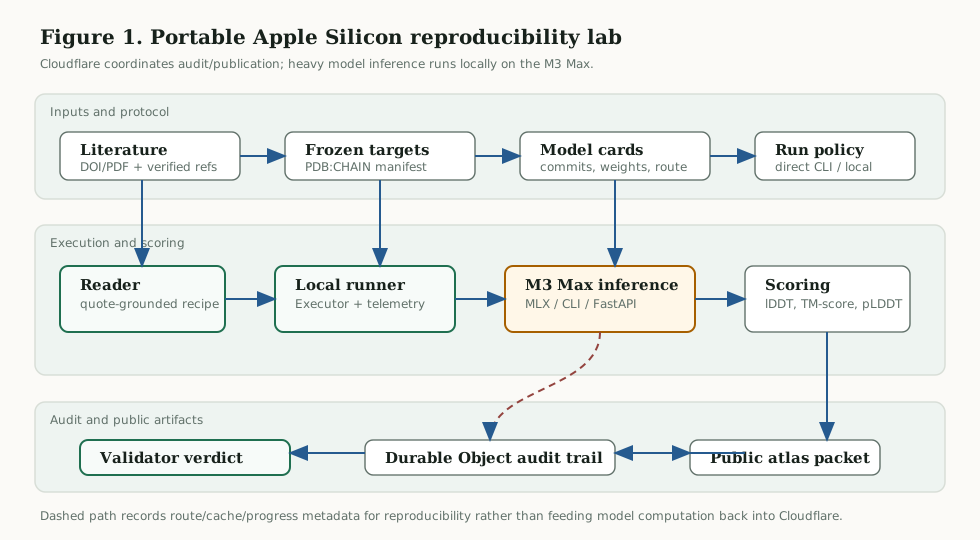
global_lddt = mean(per_residue_lddt)The benchmark is orchestrated by a hybrid Cloudflare + M3 Max stack with MCP-style services, configurable Reader/Validator agents, and an independent verifier path:
The public services expose citation verification, PDF handling, PDB retrieval, scoring, and run-state persistence. Long-running inference is deliberately separated from public synchronous HTTP routes: the final benchmark policy runs model execution directly on the M3 Max, using either the local FastAPI server for short/medium jobs or direct CLI execution for longer SimpleFold-3B jobs. Cloudflare remains responsible for auditability, metadata, public result packets, and reproducibility surfaces rather than for heavy numerical inference.
Full implementation details and reproducibility instructions are
maintained in
Theovia/eigen-reprod-atlas/docs/02_pipeline_architecture.md
and the public runbook.
pilot/data/test_set_v1_phase1a.csv and
pilot/data/test_set_v1_phase1a.json, with per-target
fixtures in pilot/fixtures/phase1a/. The larger candidate
file remains test_set_v1_candidates.csv for Phase 1B.pilot/data/phase1a_biological_review.csv and
pilot/data/phase1a_biological_review.json; external domain
review remains a final submission gate before biological generality
claims.pilot/model-cards/simplefold3b_phase1a.md and
pilot/data/simplefold3b_phase1a_environment.json, including
M3 Max hardware, macOS build, package versions, SimpleFold source
commit, USalign source commit, checkpoint sizes, and checkpoint SHA256
hashes.cite-verify MCP before
inclusion in the final reference list.recipe.json,
predictions.json, scores.json,
verdict.json, and card.json.13CZ:A mid-bin repeat/cache anchor, a new
11BC:C hard/coverage control, and a new 9K9Y:A
long-bin control.Before launching the Phase 1 benchmark, we ran a fixture-controlled
public-tunnel smoke test to validate that the end-to-end architecture
can produce real structures and real scores through the intended public
route. The runner called deployed Cloudflare Workers, the
structure-pred and scoring Workers reached the
M3 Max server through science.eigenatlas.com, and the
orchestrator persisted the run in a Durable Object.
This smoke used SimpleFold-100M on three intentionally small
engineering targets (1L2Y, 1CRN,
1UBQ). It is not a biological benchmark and does not claim
reproduction of the SimpleFold paper. It establishes that the
infrastructure can produce auditable inference and scoring
artifacts.
| Target | pLDDT mean | Wall clock seconds | lDDT | TM-score | RMSD |
|---|---|---|---|---|---|
1L2Y |
97.2065 | 112.86 | 0.9708 | 0.6739 | 0.39 |
1CRN |
90.5352 | 111.36 | 0.9867 | 0.9738 | 0.35 |
1UBQ |
87.9837 | 110.86 | 0.9650 | 0.9659 | 0.81 |
The generated fixture verdict was successful_prediction,
with median lDDT 0.9708 against the internal engineering fixture value
0.9695 (relative error 0.13%). The deployed Durable Object reported 41
audit entries, 3 prediction records, 3 score records, a saved recipe,
and a saved verdict. Public artifacts are available at
https://eigenatlas.com/eigen-reprod-atlas/results/phase0-public-tunnel-smoke/.
The Phase 1A prospective results below are now complete and summarized from result cards.
After generating the 24-chain candidate manifest, we ran a
three-target technical rehearsal using simplefold-100m on
one short, one mid-length, and one long candidate chain
(9PFE:A, 13CZ:A, 13BB:A). This
rehearsal is not a final Phase 1 benchmark result and is not used for
model-quality claims. It tests the candidate-target plumbing before
biological target approval.
The short and mid targets completed through the public Worker/Tunnel
route and produced predictions plus lDDT/TM-score records. The long
target failed with HTTP 524 on the public synchronous route and is now
tagged as orchestration_timeout. We then reran the same
long target through direct local prediction
(DIRECT_M3MAX_URL=http://127.0.0.1:8001), which completed
in 280.38 s with sequence-aligned lDDT 0.8431 and TM-score 0.9567. This
identifies a required engineering policy before the final long-bin
benchmark: long jobs should use either a direct local M3 route or an
asynchronous job/polling pattern rather than a single public synchronous
fetch.
We also ran SimpleFold-3B smokes on one short and one mid-length
candidate. The first short-target attempt downloaded the 3B checkpoint
and outlived the runner client’s request timeout; after checkpoint
caching, the resumed direct-local run on 9PFE:A completed
in 285.08 s with pLDDT mean 96.1811, lDDT 0.7505, and TM-score 0.0464. A
subsequent local HTTP attempt on the mid/long pair (13CZ:A,
13BB:A) timed out while backend 3B subprocesses continued
running, showing that even local synchronous HTTP is not a safe
execution route for longer 3B jobs. We therefore added
DIRECT_PREDICTION_MODE=simplefold_cli and reran the
mid-length target 13CZ:A; CLI mode completed in 609.38 s
with pLDDT mean 81.8822, sequence-aligned lDDT 0.8627, and TM-score
0.9270. After adding progress logging and approximate RSS sampling, a
repeated CLI telemetry run on 13CZ:A completed in 378.92 s
with peak RSS 31.4909 GB, pLDDT mean 85.2307, sequence-aligned lDDT
0.8613, and TM-score 0.9224. After adding structured
execution metadata to PredictionResult, a
third CLI repeat completed in 285.76 s with peak RSS 32.4891 GB, pLDDT
mean 84.1826, sequence-aligned lDDT 0.8569, TM-score 0.9195, and
machine-readable checkpoint/cache/progress evidence in the card. These
runs are install, orchestration, telemetry, and metadata evidence for
the native MLX 3B path, not final target-set performance.
The three 13CZ:A CLI smokes were summarized by
pilot/scripts/summarize_simplefold3b_repeats.mjs and
converted into a repeat/cache-state protocol. Across these same-target
runs, median pLDDT was 84.1826, median wall-clock time was 378.916 s,
median peak RSS across telemetry-enabled runs was 31.99 GB, median
sequence-aligned lDDT was 0.8613, and median TM-score was 0.9224. This
makes the first methodological rule explicit: one-off pLDDT and timing
values are preliminary unless they carry repeat controls or an explicit
single-run limitation.
Finally, we removed the engineering recipe fixture from the Reader
path for SimpleFold by adding a narrow manual-curation command adapter.
This no-fixture dry run extracted the SimpleFold paper title, CASP14
target list, SimpleFold-3B model path, and headline CASP14 median LDDT
value 0.709 from primary sources, producing reader_raw.txt,
recipe.json, verdict.json, and
card.json through the same runner output schema. The
validator status is successful_with_caveat, because no
inference was executed and the scores are dry-run schema values. This is
sufficient for protocol curation in the benchmark paper; it is not yet
evidence of autonomous Reader-agent extraction.
We then added an explicit benchmark-slice verdict mode and ran three
provisional Phase 1 targets from the target-review triage with
SimpleFold-3B. In benchmark mode, the runner preserves prediction,
scoring, card generation, and audit persistence, but reports
successful_with_caveat rather than a paper-reproduction
verdict. The two mid-bin targets completed and scored:
13EE:A produced pLDDT 81.6716, wall-clock 401.635 s, peak
RSS 38.5429 GB, sequence-aligned lDDT 0.8582, TM-score 0.9212, and RMSD
1.68; 13FT:A produced pLDDT 92.9916, wall-clock 390.276 s,
peak RSS 31.2522 GB, sequence-aligned lDDT 0.8915, TM-score 0.9588, and
RMSD 1.23. We then added the hard-bin complex-context target
11BC:C, which completed with pLDDT 81.2384, wall-clock
337.455 s, peak RSS 41.4060 GB, sequence-aligned lDDT 0.7492, TM-score
0.6569, RMSD 1.97, and 63 aligned reference residues. Across the three
provisional slices, median wall-clock time was 390.276 s, median peak
RSS was 38.5429 GB, median sequence-aligned lDDT was 0.8582, and median
TM-score was 0.9212. These target-level benchmark-slice results,
together with the 13CZ:A repeat-control target, are
recorded as pre-freeze evidence inside the frozen Phase 1A set. The
remaining four targets were then executed prospectively after the
freeze.
| Target | Bin | Outcome | pLDDT mean | Wall clock seconds | lDDT | TM-score | Failure tag |
|---|---|---|---|---|---|---|---|
9PFE:A |
short | predicted and scored | 95.9711 | 117.69 | 0.7395 | 0.0482 | n/a |
13CZ:A |
mid | predicted and scored | 71.5778 | 115.44 | 0.8532 | 0.9004 | n/a |
13BB:A |
long | public synchronous prediction timed out | n/a | n/a | n/a | n/a | orchestration_timeout |
| Target | Model | Route | Outcome | pLDDT mean | Wall clock seconds | lDDT | TM-score | Failure tag |
|---|---|---|---|---|---|---|---|---|
9PFE:A |
simplefold-3b |
direct local HTTP, cached checkpoint | predicted and scored | 96.1811 | 285.08 | 0.7505 | 0.0464 | n/a |
13CZ:A |
simplefold-3b |
direct local CLI | predicted and scored | 81.8822 | 609.38 | 0.8627 | 0.9270 | n/a |
13CZ:A |
simplefold-3b |
direct local CLI, telemetry repeat | predicted, scored, peak RSS captured | 85.2307 | 378.92 | 0.8613 | 0.9224 | n/a |
13CZ:A |
simplefold-3b |
direct local CLI, execution metadata repeat | predicted, scored, checkpoint/cache metadata captured | 84.1826 | 285.76 | 0.8569 | 0.9195 | n/a |
| Benchmark-slice target | Bin | Length | pLDDT mean | Wall clock seconds | Peak RSS GB | lDDT | TM-score | Aligned residues |
|---|---|---|---|---|---|---|---|---|
11BC:C |
hard | 116 | 81.2384 | 337.455 | 41.4060 | 0.7492 | 0.6569 | 63 |
13EE:A |
mid | 161 | 81.6716 | 401.635 | 38.5429 | 0.8582 | 0.9212 | 148 |
13FT:A |
mid | 228 | 92.9916 | 390.276 | 31.2522 | 0.8915 | 0.9588 | 212 |
All negative and ambiguous observations are retained in a dedicated
difficulty log (docs/24_phase1_difficulty_log.md) before
being abstracted into manuscript limitations. Current logged issues
include public Worker/Tunnel timeout on long inference,
residue-numbering assumptions in lDDT scoring, checkpoint-download
timeout, direct HTTP unsuitability for longer 3B jobs, CLI
progress-observability gaps, per-run auxiliary cache materialization,
repeat-run variability in confidence/timing, and the need for
machine-readable execution metadata. The lDDT scorer now uses
single-chain sequence alignment so model-numbered predictions can be
compared to PDB-numbered references. The corresponding
repeat/cache-state protocol is published as
docs/28_simplefold3b_repeat_cache_protocol.md.
After the computational freeze, we ran the four prospective targets
(12OY:A, 9H8N:A, 9K9X:A,
9K9Y:A) through the same direct SimpleFold-3B CLI route.
All four produced predictions and scores. Combined with the four
pre-freeze targets, the frozen Phase 1A set is now complete: 8/8 targets
scored, with median wall-clock time 395.96 s, median peak RSS 34.08 GB,
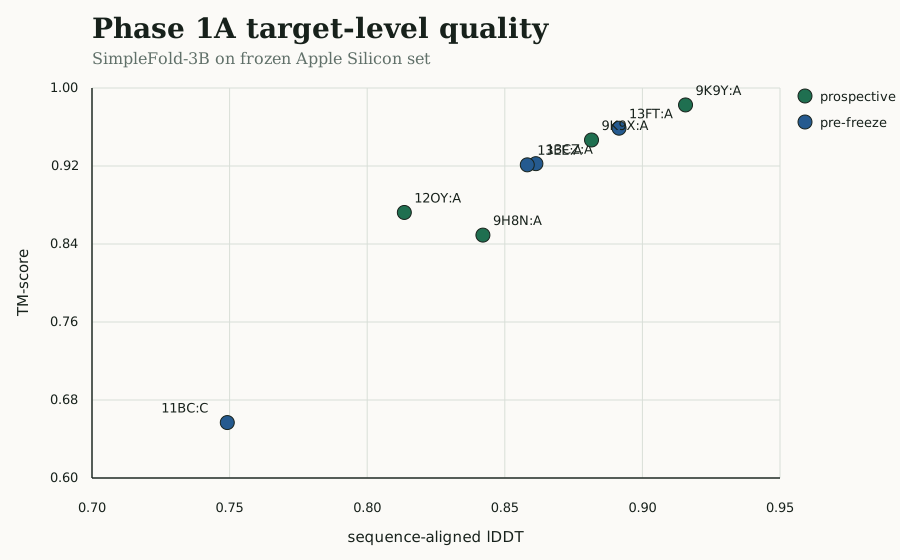
median sequence-aligned lDDT 0.8597, and median TM-score 0.9218. The
four prospective targets alone had median wall-clock time 726.63 s,
median peak RSS 34.08 GB, median lDDT 0.8618, and median TM-score
0.9095.
| Target | Stratum | Bin | Length | pLDDT mean | Wall clock seconds | Peak RSS GB | lDDT | TM-score | RMSD | Aligned residues |
|---|---|---|---|---|---|---|---|---|---|---|
13CZ:A |
pre-freeze | mid | 161 | 84.1826 | 378.916 | 31.9900 | 0.8613 | 0.9224 | 1.65 | 150 |
13EE:A |
pre-freeze | mid | 161 | 81.6716 | 401.635 | 38.5429 | 0.8582 | 0.9212 | 1.68 | 148 |
13FT:A |
pre-freeze | mid | 228 | 92.9916 | 390.276 | 31.2522 | 0.8915 | 0.9588 | 1.23 | 212 |
11BC:C |
pre-freeze | hard | 116 | 81.2384 | 337.455 | 41.4060 | 0.7492 | 0.6569 | 1.97 | 63 |
12OY:A |
prospective | hard | 304 | 87.7506 | 308.066 | 33.2323 | 0.8135 | 0.8724 | 2.84 | 285 |
9H8N:A |
prospective | long | 604 | 88.1646 | 739.974 | 34.6408 | 0.8420 | 0.8491 | 3.68 | 568 |
9K9X:A |
prospective | long | 565 | 95.8087 | 713.290 | 34.0239 | 0.8815 | 0.9467 | 1.96 | 522 |
9K9Y:A |
prospective | long | 565 | 96.2908 | 753.399 | 34.1274 | 0.9157 | 0.9826 | 1.07 | 487 |
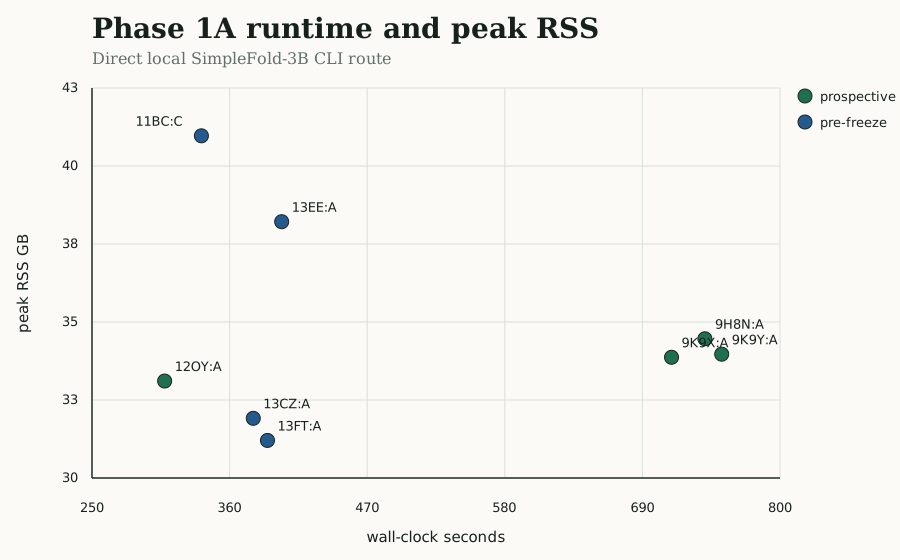
The long-bin targets (9H8N:A, 9K9X:A,
9K9Y:A) completed without OOM or route timeout. Their
wall-clock range was 713.290-753.399 s and their peak RSS range was
34.0239-34.6408 GB. This supports a narrow viability finding for this
hardware, route, model, and target set: long-target SimpleFold-3B
inference on the M3 Max was runtime-bounded rather than
memory-bounded.
We then added selective repeat controls for the two
reviewer-sensitive cases: the hard/coverage target 11BC:C
and the long-bin target 9K9Y:A. Combined with their
original runs, each now has n=3. 11BC:C preserved the
coverage caveat across all repeats: aligned residues remained exactly
63, with median pLDDT 80.7909, median wall-clock time 299.255 s, median
peak RSS 33.4526 GB, median lDDT 0.7492, and median TM-score 0.6520.
9K9Y:A preserved high long-bin structural scores across all
repeats: aligned residues remained 487, with median pLDDT 95.8859,
median wall-clock time 806.112 s, median peak RSS 34.1274 GB, median
lDDT 0.9131, and median TM-score 0.9826. These repeats strengthen the
narrow viability claim while reinforcing the caution that wall-clock
time varies more than structure-quality metrics. Only three
reviewer-sensitive targets have n=3 controls; the remaining five Phase
1A targets support completion and target-level viability, not
runtime-distribution estimates.
The Phase 1A benchmark is not reported as reproduction of the
SimpleFold paper headline metric. The no-fixture manual Reader bridge
extracted the SimpleFold-3B CASP14 median LDDT value 0.709, but Phase 1A
uses a new frozen target set rather than the paper’s CASP14 evaluation
set. We therefore report target-level viability and quality directly,
with successful_with_caveat verdicts where no published
headline metric is being reproduced.
No Phase 1A frozen target failed inference or scoring. The
failure-mode result for this set is therefore not an OOM table but an
evidence-quality finding: 12OY:A and 9H8N:A
were preserved through primary result cards before terminal
tee logging was added, while 9K9X:A and
9K9Y:A additionally have terminal logs under
pilot/evidence/phase1a/logs/. Final numeric claims trace to
card.json, scores.json, and
pilot/data/simplefold3b_phase1a_summary.*; screenshots and
terminal logs are supplemental reviewer aids.
The corresponding install/runtime evidence is also now public. The
Phase 1A SimpleFold-3B card records the workstation model
(Mac15,9), Apple M3 Max/128 GB hardware, macOS 26.5 build
25F71, SimpleFold package version 0.1.0,
SimpleFold source commit
c7a5570a6be9f5c695126e27c804e77567209934, USalign version
20260329, and SHA256 hashes for
simplefold_3B.ckpt and plddt.ckpt. This
prevents the benchmark from depending on an implicit local setup.
At the current stage, this study supports a bounded empirical claim: SimpleFold-3B can be run and scored across the frozen Phase 1A set on a 128 GB M3 Max workstation, with public machine-readable artifacts and explicit caveats. Practical model viability on Apple Silicon cannot be inferred from model openness, headline accuracy, or even a successful short-target smoke. It must be measured through the combined chain of installation, route selection, inference, scoring, telemetry, and public artifact generation.
The most important early finding is that execution route is not
incidental infrastructure. The same portable lab exposed three distinct
operational regimes: public Worker/Tunnel execution, direct local HTTP
execution, and direct CLI execution. Public synchronous prediction was
adequate for small SimpleFold-100M smokes but produced an HTTP 524 on
the long 13BB:A rehearsal target. Direct local HTTP
recovered that target, showing that the public failure was an
orchestration limit rather than a model-viability result. For
SimpleFold-3B, local HTTP still failed as a long-job wrapper, while
direct CLI execution completed and allowed the runner to add
process-level telemetry. These observations justify treating route as a
recorded experimental variable.
The repeated 13CZ:A, 11BC:C, and
9K9Y:A SimpleFold-3B CLI runs show why timing and
confidence should not be overinterpreted from a single run. lDDT,
TM-score, and aligned-residue coverage stayed close within each repeated
target, but wall-clock time and sampled peak RSS varied enough to
require repeat-aware reporting. Phase 1A therefore reports timing and
memory as observed values or repeat medians/ranges, not as calibrated
hardware constants.
The first benchmark slices extend that caution from repeated-run
controls to scoring instrumentation. Their initial cards showed high
TM-score but low lDDT; audit revealed that model predictions were
numbered from residue 1 while PDB references retained source residue
numbering. After switching to single-chain sequence-aligned lDDT,
13EE:A corrected from 0.2368 to 0.8582 and
13FT:A corrected from 0.2429 to 0.8915. The later
11BC:C hard-bin slice added a different caution: even when
sequence identity is 1.0, only 63 reference residues aligned because the
reference is complex-derived and partially observed. This is a
methodological result: final Phase 1 must treat metric implementation,
sequence alignment, reference-state handling, and alignment coverage as
part of the scientific apparatus.
The Phase 1A prospective runs add the first positive stress result: three long-bin targets from 565 to 604 residues completed without OOM at approximately 34-35 GB peak RSS. This does not mean Apple Silicon is generally sufficient for contemporary protein-structure inference. It means that, for this SimpleFold-3B route and this target set, the limiting practical factor was wall-clock time rather than memory collapse. The lower-scoring membrane/complex cases also show why “runs locally” and “biologically strong” are separate claims.
The paper’s contribution is therefore a viability map, not a model leaderboard. Native MLX paths, community ports, and CUDA-first repositories are expected to fail in different ways. Those failures are scientifically useful if they are recorded precisely enough that another researcher can distinguish install friction, route artifact, memory pressure, scoring mismatch, and genuine model-output drift. We explicitly do not claim a ranking of model quality or biological generality at this stage.
port_quality_drift failure
tag was created for this exact ambiguity.13CZ:A mid-bin anchor, 11BC:C hard/coverage
control, and 9K9Y:A long-bin control.11BC:C aligned 63 residues despite a 116-aa target label,
so final tables must report alignment coverage with lDDT.12OY:A and 9H8N:A still
have primary card/scores/prediction evidence, but not tee
terminal logs.This work frames Apple Silicon viability as an empirical question rather than an assumption. Phase 0 establishes that a single researcher can run, score, and publicly audit real SimpleFold-100M predictions through the proposed stack. Phase 1A answers a narrower first publishable question: SimpleFold-3B ran and scored across an 8-target frozen Apple Silicon benchmark, with quality, throughput, memory, alignment coverage, and evidence limitations reported as public artifacts.
External biological, technical, or academic review, if obtained before submission, will be acknowledged only with the reviewer’s permission and with a specific description of the contribution. We thank the Apple ML Research team for releasing SimpleFold and the community maintainers who make local protein-structure inference paths inspectable. We acknowledge a mid-session mis-verification incident in our own earlier work and the subsequent design of the cite-verify MCP as motivation for the citation-verification infrastructure included here. ChatGPT/Codex was used for coding assistance, drafting support, and artifact organisation; the human author reviewed the outputs and remains responsible for the accuracy, integrity, originality, and final wording of the manuscript.
Auto-generated from paper/references.bib at PDF
render. See file for entries.